CSSE 1 Journey
In CSSE 1, from a hesitant beginner, I became a confident developer by learning and practicing with essential coding tools such as VSCode, Github, Ubuntu, and the Terminal.
Serving as a Scrum Master, I’ve led my team through the development of the mini lesson: Data Abstraction , and the development of a Murder Mystery Game Level 1
For these projects, I learned how to create detailed blogs, notebook files, posts, and have managed Kanban boards, to organize Level 1 planning and a team-teach lesson.
I have also learned how to navigate the Software Development Lifecycle (SDLC), by debugging player hitboxes, collaborating with other students, ideating projects, and determining roles!
CSSE 2 Journey
Building on my foundations from the first trimester of CSSE 1, CSSE 2 has helped me focus more on game building through software engineering and object oriented programming. I have moved beyond learning the basics of coding to creating game levels using data-driven design and sprites.
By collaborating with other students, and adopting roles such as both a technologist and scrummer, I’ve advanced my skills in Javascript, my knowledge about components of a running game, and documentation
Projects I've Done
Data Abstraction Team Teach Lesson:
https://pages.opencodingsociety.com/js/data-abstraction
Murder Mystery Game Level 1:
https://pages.opencodingsociety.com/gamify/murderMystery
Red Riding Hood Game:
https://rashig-1804.github.io/new_csse2_team/gamify/redridinghood
#1. Software Engineering and SDLC
To manage an organized repository and workflow, my teams would utilize scrum and agile practices.
I contributed to Kanban Boards, breaking down the games into manageable issues and tasks
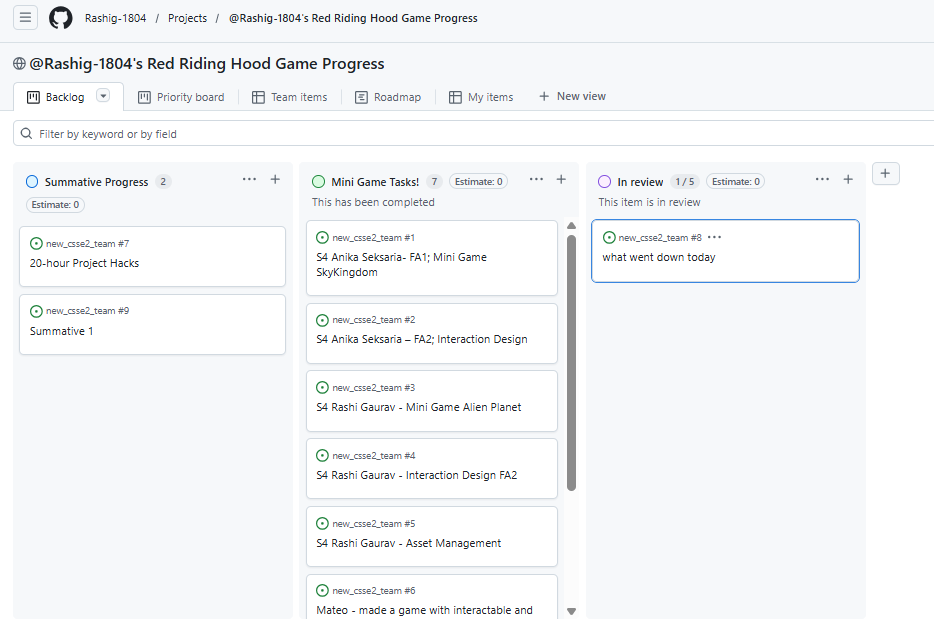
Red Riding Hood Game
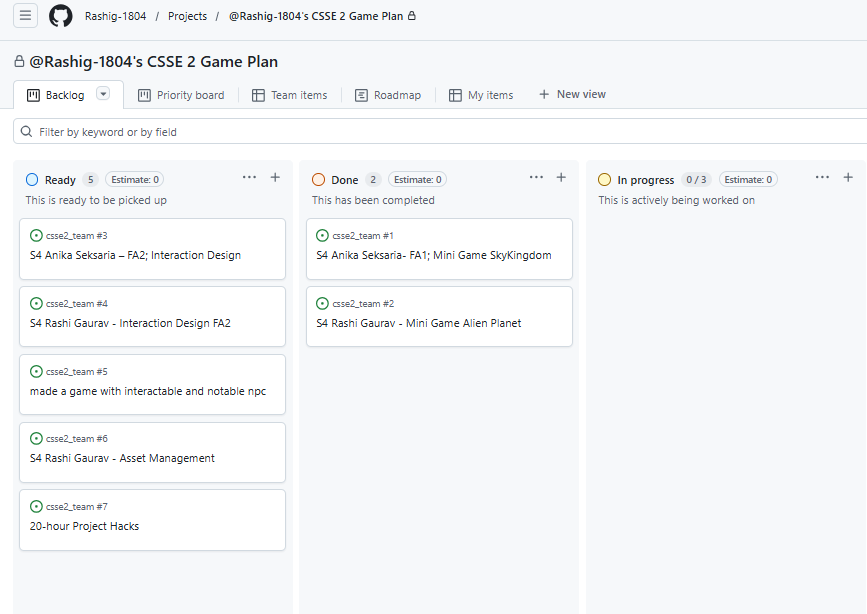
Mini Games Planning
I also always debug and error handle through tools like inspect and console
(This is an image of me checking the hitbox of the player and determining how to fix the size)
JS Documentation
I added JS documentation of > 10% density in the overall code, to explain the methods and technical features added.
Example
#2. Object Oriented Programming
In the development of the Red Riding Hood, I used an object-oriented approach. By using classes and inheritance, we created a game where every element, including the Player and Wolf, behaves as an independent object with its own properties and methods.
Inheritance
The core of our games is built on inheritance. Instead of rewriting movement, we learned specific characters can “inherit” traits from a base class.
Example: In Level 2 of Red Riding Hood, the Wolf class uses the extends keyword to inherit from the Character base class
#3.